
Quick Answer
Wearable app development is the process of building software for smartwatches, fitness bands, rings, and other connected devices, usually paired with a companion mobile app that handles data syncing, storage, and deeper analysis. Depending on features, platform coverage, and compliance needs, wearable app development cost typically falls somewhere between $10,000 and $100,000+.
Introduction
A decade ago, wearable technology was essentially a secondary display device that would reflect notifications from your smartphone. That is not true anymore. Modern-day wearables have all the power to do health computations on their own, detect an abnormal heart rate, and have sufficient processing power to work without a connection to the smartphone for hours. This change in technology has altered the nature of wearable applications development.
The numbers back up why more businesses are paying attention. According to Intel Market Research, the global wearable device app development service market was valued at $4.64 billion in 2025 and is projected to grow to $15.34 billion by 2034 at an 18.8% CAGR. Fortune Business Insights puts the broader wearable technology market at $86.78 billion in 2025, climbing toward $231.43 billion by 2034, with health and fitness monitoring cited as one of the primary growth drivers.
Whether you’re a health-tech founder, a fitness brand extending an existing app, or an enterprise team building an internal wearable tool, this guide covers what wearable devices app development actually involves: the features that matter, what it costs, and how to evaluate a development partner properly.
Key Takeaways
- Wearable app development typically means building two connected pieces: the on-device app and a companion mobile app that handles heavier processing, storage, and account management.
- Core features fall into three buckets: health and activity tracking, connectivity and sync, and lightweight interaction (notifications, quick actions, voice).
- Realistic budgets generally run from $10,000 for a simple notification and tracking app up to $100,000+ for a health-grade platform with compliance, AI insights, and multi-device support.
- Battery efficiency and offline-first design matter as much as feature richness. A wearable app that drains the battery gets uninstalled fast, regardless of what it can do.
- Picking a development partner with real device-level experience, not just mobile app experience, is the single biggest factor in whether a wearable build actually performs well on-device.
What Is Wearable App Development?
Wearable app development refers to the design and creation of software that works for wearable devices, like smart watches, health trackers, smart rings, or augmented reality (AR) glasses, instead of a phone or web browser interface. There are a number of differences between developing an app for wearables and normal mobile apps, including limited screen real estate or lack thereof, battery power limitations, and the need to continue functioning even without being connected to a paired phone.
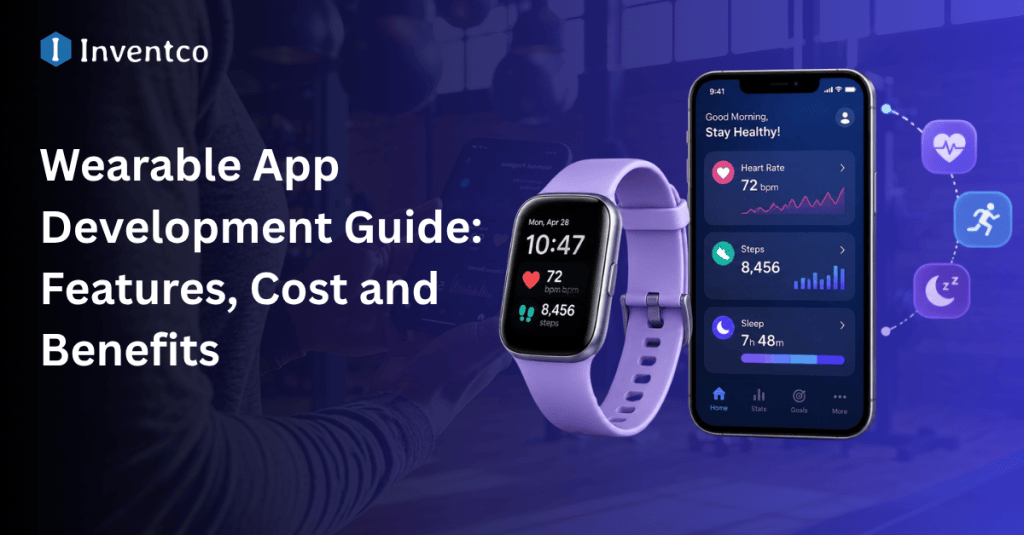
Most wearable device app development projects are actually two builds in one: a lightweight app or watch face that runs on the device itself, and a companion mobile app that syncs data, stores history, and handles anything too resource-intensive for the wearable’s limited hardware. Getting that division of labor right is usually what separates a wearable app that feels fast from one that feels laggy and gets uninstalled within a week.
Why Businesses Are Investing in Wearable Devices App Development?
Three forces are driving demand right now. First, consumer health awareness has pushed adoption of fitness trackers and smartwatches well past the early adopter phase. Coherent Market Insights reports that fitness and wellness applications hold roughly a third of the entire wearable technology market by application type. Second, enterprises are finding practical uses beyond fitness, including logistics teams using wrist worn scanners, field technicians using hands free AR displays, and healthcare providers using remote patient monitoring wearables. Third, the underlying hardware has simply gotten more capable, which means wearable devices app development can now support real time analytics and on-device AI instead of just step counting. That shift is one we touched on in our piece on the role of AI in fitness app development, where real time biometric adaptation is one of the fastest growing trends.
For fitness and coaching brands specifically, this ties directly into features we cover in our guide on fitness trainer app development, where wearable sync has moved from a nice to have to a baseline expectation for any coaching or training platform.
Core Features Every Wearable App Needs
1. Health & Fitness Tracking Features
Heart rate monitoring, step and activity tracking, sleep analysis, and workout detection form the baseline for almost any consumer-facing wearable app. The more advanced tier includes SpO2 monitoring, ECG style heart rhythm checks, and recovery scoring built from combined biometric data.
2. Connectivity & Sync Features
Bluetooth Low Energy (BLE) pairing, background sync to a companion mobile app, and offline data caching are essential. A wearable app that loses data the moment it goes out of Bluetooth range isn’t usable in the real world. Cloud sync for cross-device access rounds this out for most modern builds.
3. Notification & Interaction Features
Smart notification filtering, quick reply actions, voice commands, and simple on-device controls (starting a workout, pausing a timer) make up the interaction layer. The goal on a small screen is always fewer taps, not more features crammed into a tiny interface.
Wearable App Development Cost Breakdown
| Tier | Typical Scope | Estimated Cost |
| Basic | Notifications, basic activity tracking, simple companion app | $10,000 to $30,000 |
| Mid-Range | Multi-metric health tracking, cloud sync, cross-platform companion app | $30,000 to $65,000 |
| Advanced | AI driven insights, health-data compliance (HIPAA/GDPR), multi-device support | $65,000 to $100,000+ |
Wearable app development cost is driven less by the visual design and more by the engineering work behind the scenes. Sensor data processing, battery optimization, and offline sync logic account for a large share of development hours on most projects. Platform coverage also matters: building for watchOS and Wear OS at once roughly doubles the device-side testing and optimization work compared to a single-platform build, which is one of the main reasons wearable app development cost estimates vary so widely between vendors.
How to Choose a Wearable Devices App Development Company?
Not every mobile development shop has genuine device-level experience. When evaluating a wearable devices app development company, look for a few specific signals rather than a general portfolio:
- Device-specific delivery history: actual shipped watchOS or Wear OS apps, not just phone apps with a “wearable-ready” claim
- Battery and performance optimization experience: ask for real examples of how they’ve handled background processing without draining the device
- Health-data compliance familiarity: HIPAA, GDPR, and platform-specific health data policies (Apple HealthKit, Google Fit) if your app touches biometric data
- Companion app architecture: a clear plan for what runs on-device versus what runs on the phone or cloud
Any company making wearable devices apps that cannot effectively communicate regarding the above topics will probably approach your wearable development as an afterthought, which is tacked on to your smartphone application, and will eventually end up as lagging and low battery power when actual people start wearing it. This is the exact criteria we would like you to consider when developing your fitness training app, as outlined in our fitness app development guide.
Wearable App Development Services USA: What to Look For
When you are trying to choose between the wearable app development services USA vendors and those located abroad, then the key issues will be overlapping communication skills, understanding of regulations, and pricing. Generally speaking, the wearable app development services USA vendors will have better knowledge of handling health data according to the FDA guidelines and also payment compliance for your wearable app if it is related to health care. Nevertheless, a lot of wearable app development services USA vendors today work with a distributed engineering team all over the world, so “US-based” may mean US-based project management and QA with the distributed engineering team.
Android Wearable App Development Company vs. iOS-First Builds
Choosing between an Android wearable app development company and an iOS-first (watchOS) approach depends heavily on your target audience and hardware ecosystem. Wear OS (Android’s wearable platform) offers broader hardware diversity across brands like Samsung, Pixel Watch, and various fitness-focused manufacturers, while watchOS is a single, tightly controlled ecosystem tied to the iPhone. An android wearable app development company will typically need to account for more device variation in screen size, sensor availability, and battery capacity than a team building exclusively for Apple Watch. Many businesses end up building for both, but sequencing matters. Validating your core feature set on one platform before doubling the device-testing workload on a second is usually the more budget-efficient path.
What Makes the Best Wearable App Development Services?
Among the qualities common to good wearable app development services, no matter the size of the company providing them, is the scoping of an MVP that is minimal and testable before advising a full version with all bells and whistles, the ability to show actual metrics of performance of their work on the device side from previous projects (and not just screenshots of app stores) and to consider compliance and battery optimization engineering problems from the get-go instead of as afterthoughts. If the features are discussed by a vendor and there is not even a mention of the battery life, offline capability or limitations of the platform, then it is quite likely that the project will be treated more as a phone app with less screen real estate.
Why Inventco for Wearable App Development?
At Inventco, wearable integration isn’t treated as a bolt-on feature. It’s built by the same in-house AI and mobile engineering team handling the rest of the product, which is part of why our fitness and wellness builds sync cleanly with Apple Watch, Fitbit, Garmin, Oura, Polar, and Whoop out of the box. Our team designs the on-device and companion-app split up front, rather than retrofitting wearable support after a phone app is already built, and we bring HIPAA and GDPR aware data handling into the architecture from day one for any build that touches biometric data.
With 12+ years of experience and 750+ delivered digital products, our engineering team has shipped wearable-integrated builds across fitness, healthcare, and wellness use cases. If wearable support is core to your product rather than an add-on, our IoT and wearable app development practice is a good place to start the conversation.
Conclusion
App development on wearables favors those who understand the limitations of the device itself small screen size, limited battery life, and limited connectivity, rather than looking at it as a downscaled version of the phone app. Get the device app and accompanying app balance right, accurately allocate budget for the effort that goes into sensor input processing and battery optimization, and pick a partner who demonstrates the ability to deliver on the device level, not just boast of features. With all of this done right, a wearable app will become your true competitive advantage, not an afterthought.
If you’re ready to scope a build, talk to Inventco’s team about what a realistic wearable app development plan looks like for your product.
FAQs
Q1. How much does wearable app development cost?
Costs typically range from $10,000 for a basic app with tracking and notifications to $100,000+ for an advanced build with AI driven insights and health-data compliance.
Q2. How long does it take to build a wearable app?
A basic wearable app usually takes 10 to 14 weeks. A mid-range or advanced build with multi-platform support and compliance requirements can take 5 to 8 months.
Q3. Do I need a companion mobile app alongside my wearable app?
In most cases, yes. Wearable hardware has limited processing power and storage, so a companion phone app typically handles account management, deeper analytics, and long-term data storage.
Q4. Should I build for watchOS, Wear OS, or both?
It depends on your audience. Many teams validate their core feature set on one platform first, then expand to the second once there’s real usage data to justify the additional development and testing cost.

 Fitness App Development Company
Leave a comment